Podcasts · Video · Long-form

Take one real question all the way—and help the conversation travel farther.

You set the question. I’ll bring first-hand experience and evidence, and we’ll follow the question wherever it leads. We can use your usual format; my team can also help with editing, clips, and co-publishing.

Yuzheng Sun in conversation with Ben Gilbert and David Rosenthal of Acquired
With Ben Gilbert and David Rosenthal of Acquired · Significance Summit
Research to practice
Cornell PhD · Amazon · Meta · Tencent · Statsig
Long-form experience
Conversations with 150+ guests · 33 verified guest appearances
Cross-platform
YouTube · Bilibili · Xiaohongshu · 400K+ followers
Production-ready
Remote or Seattle · editing and co-publishing available
Three collaborations · Three kinds of proof

Good content should hold on its own, reward further investment—and travel to a different audience.

The Koji episode shows what the conversation can do with a simple remote setup and the host’s own channels. The Tulong episode shows what can happen when both teams edit, distribute, and build around the same recording. The Yang Tiannan episode began with a topic I proposed and ran on a personal-finance podcast: 45K plays in under two weeks.

Crossing with Koji × Yuzheng Sun
Case 1 · The content holds

A remote conversation crossed long-form audio and three video platforms

Crossing with Koji × Yuzheng Sun

  • 67KXiaoyuzhou playsShow Top 2
  • 12KDouyin likesAccount all-time high
  • 8,343Xiaohongshu savesAccount annual high
  • 6,502WeChat Channels sharesCross-platform sharing

A 63-minute remote recording became one of Crossing’s two most-played episodes. Its clips set Koji’s all-time Douyin like record and annual Xiaohongshu save record. Koji’s team handled the production and publishing; my accounts did not co-publish, so the result is unusually clean evidence of the topic and conversation itself.

Also: 132 Xiaoyuzhou comments; 4,709 Xiaohongshu likes; 8,582 Douyin saves and 1,476 shares.

“A genuinely useful episode. I’m moving from ChatGPT to Codex and building up my context.” — Xiaoyuzhou listener
Listen on Xiaoyuzhou
View platform screenshots (4)

Crossing episode listed among the most popular with 67K plays and 132 comments
Xiaoyuzhou · 67K plays · 132 commentsOpen full screenshot
Koji clip on Xiaohongshu with 4,709 likes and 8,343 saves
Xiaohongshu · 4,709 likes · 8,343 savesOpen full screenshot
Koji clip on Douyin with 12K likes, 8,582 saves and 1,476 shares
Douyin · 12K likes · account recordOpen full screenshot
Koji clip on WeChat Channels with 6,502 shares
WeChat Channels · 6,502 sharesOpen full screenshot
Yuzheng × Yang Ying (Tulong)
Case 2 · Both sides amplify

Two teams made different cuts—and introduced the guest to new audiences

Yuzheng × Yang Ying (Tulong)

  • 58.7KXiaohongshu likesCo-published
  • 59.6KXiaohongshu savesMore saves than likes
  • 110K+YouTube viewsNew viewers discovered Tulong
  • 108K+Bilibili viewsLong-form reach

Tulong’s team kept the voice of her show. Our team made a second long-form version and clips for Xiaohongshu, YouTube, Bilibili, and the Superlinear community. The collaboration produced breakout numbers and brought Tulong to viewers who had never encountered her before.

Also: 11.3K Xiaohongshu shares and 1,088 comments; 3.6K YouTube likes and 481 comments; 8,026 Bilibili saves.

“I hadn’t known her before, but she’s incredibly cool. I hope they talk every year so we can see how her thinking changes.” — YouTube viewer (translated)
Watch the YouTube cut and comments
Verify the latest Xiaohongshu result (1 screenshot)
Yuzheng and Tulong co-created Xiaohongshu video with 58.7K likes, 59.6K saves, 11.3K shares and 1,088 comments
Our cut · 58.7K likes · 59.6K saves · 11.3K shares · 1,088 commentsOpen full screenshot
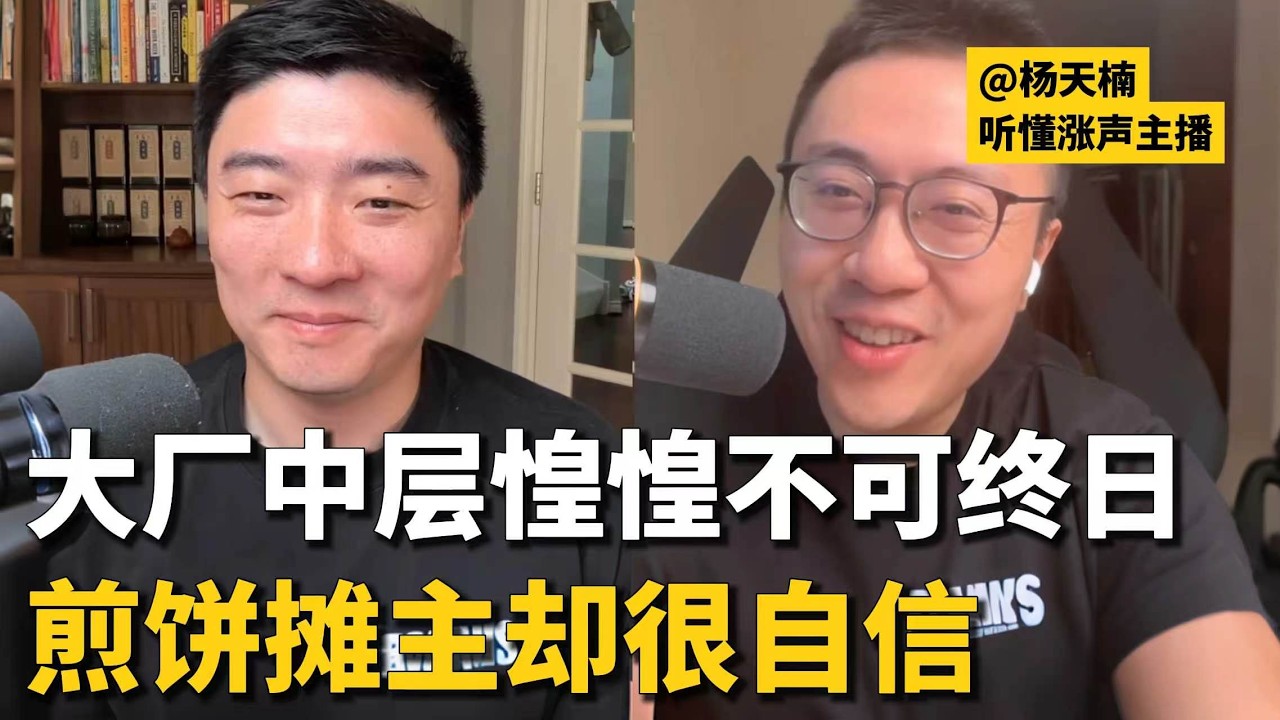
听懂涨声 with Yang Tiannan × Yuzheng Sun
Case 3 · A different audience

A topic I proposed became an episode of a personal-finance podcast

听懂涨声 with Yang Tiannan × Yuzheng Sun

  • 45KXiaoyuzhou playsIn under two weeks
  • 175KXiaohongshu viewsA 71-minute video
  • 4,220Xiaohongshu savesClose to likes
  • 1,480Xiaohongshu sharesCo-published

听懂涨声 is a Chinese podcast about family wealth, spending, and investing, with 190K+ subscribers on Xiaoyuzhou. I proposed “fake work” to its host, Yang Tiannan—the second question in the list below. He made the conversation an episode of his own show, where listeners used the comments to talk about their own jobs. Our team cut a 71-minute video and co-published it on Xiaohongshu.

Also: 113 Xiaoyuzhou comments and 534 saves; 4,660 Xiaohongshu likes and 113 comments; 17K YouTube views.

“So when Yuzheng proposed this topic, I said yes right away.” — Yang Tiannan, in the episode’s show notes (translated)
Listen to the episode on Xiaoyuzhou
View platform screenshots (2)
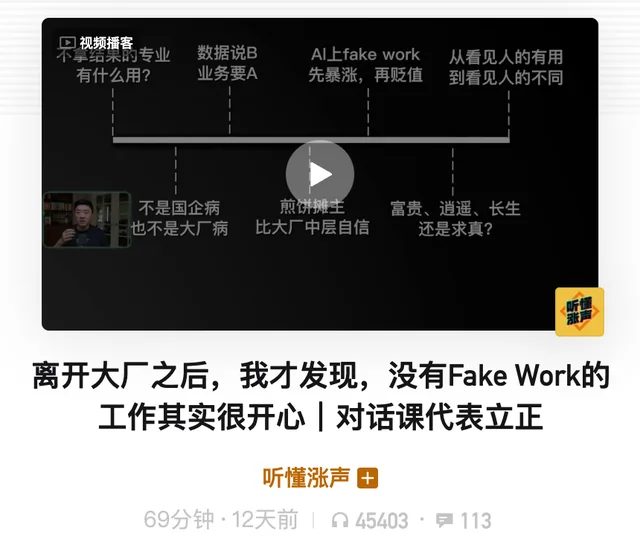
The 听懂涨声 episode page on Xiaoyuzhou with 45,403 plays and 113 comments
Xiaoyuzhou · 45K plays · 113 commentsOpen full screenshot
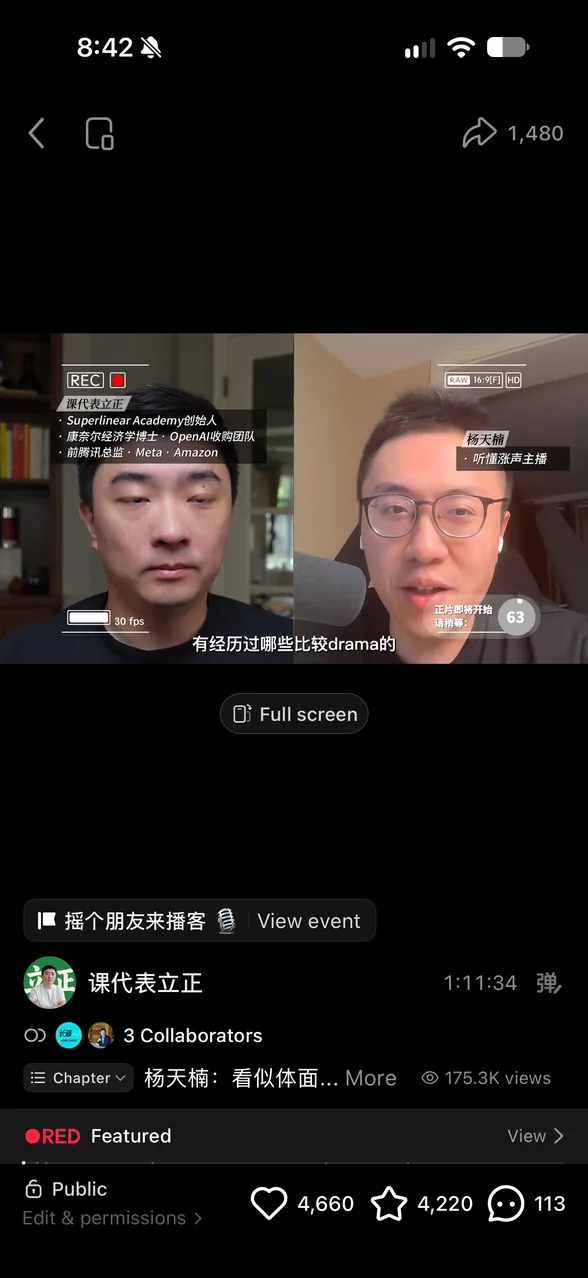
The co-published video on Xiaohongshu with 175.3K views, 4,660 likes, 4,220 saves, 1,480 shares and 113 comments
Xiaohongshu · 175K views · 4,220 saves · 1,480 sharesOpen full screenshot

Counts for the first two cases come from public platform pages and screenshots captured in July 2026; the third was captured on November 9, 2026, less than two weeks after release. Platforms use different counting methods.

Where an episode could begin

Four questions that can carry a full conversation.

Choose the one your audience is already living through. We can take it from a sharp opening claim into mechanisms, first-hand cases, disagreement, and practical consequences.

  • When AI makes ‘being able to make’ cheap, why does a defining body of work matter more?

    As acceptable first drafts multiply, the scarce parts move to choosing the problem, setting the standard, exercising craft, remaining recognizably responsible, and staying with the work. A defining work also compounds context, trust, and the next opportunity.

    MAKE WHAT LASTS · creator work · real projects

  • Will AI eliminate fake work—or make it far easier to manufacture?

    AI can remove the interface tax between work and results. It can also produce reports, meeting notes, and visible activity at almost no cost. What should an organization measure when busyness becomes abundant?

    Organizational design · incentives · enterprise AI

  • What actually makes someone AI-native?

    Tool fluency is the visible part. The deeper shift is to start from the result, recompute the whole workflow, build compounding context with AI, and remain accountable for the outcome.

    AI Builders · 900+ community projects · enterprise programs

  • How does a company know when its judgment is wrong?

    Data, experiments, and professional process can correct a mistake—or fortify it. Across Amazon, Meta, Tencent, and Statsig: when do organizations get closer to reality, and when do they merely become better at explaining themselves?

    Economics · data science · big tech and startups

Other directions include the public AI calls I made before GPT-4, experimentation, creator businesses, China–U.S. technology, and the design of AI education and community. One real question is stronger than a complete tour.

Where the view comes from

I have met the same questions from several sides.

Research, products, organizations, and early-stage work

A Cornell Economics PhD led to work at Amazon, Meta, Tencent, and the early Statsig team. At Tencent I led a 30-person Data & AI team and received the highest performance rating in two consecutive cycles.

Mechanisms · product judgment · organizational reality

Keep the original judgment—and the corrections—public

In 2021 I described the ceiling of the dominant AI paradigm. In February 2023, before GPT-4, I argued that ChatGPT had begun to break it—and reasoned forward to cheaper inference, tool use, persistent memory, and AI-native systems. The original probabilities and later corrections remain public.

A dated, public chain of reasoning

Put the ideas inside a system I am responsible for

At Superlinear, the ideas meet courses, a 30,000+ member community, 900+ real projects, enterprise programs, and public conversations with 150+ guests. They have to remain useful after the talk is over.

Superlinear Academy · real projects · enterprise work

Guest appearances

The shows that have had me on.

33 episodes since 2020. Silicon Valley 101 (硅谷101), What’s Next, 中国好生意 and 听懂涨声 each have more than 190K subscribers on Xiaoyuzhou, the main Chinese podcast app. INDIGO TALK, The Build Log and Chinese Radio Seattle have each invited me twice. Every episode is linked.

Complete recordOpen all 33 appearancesListed by year, for producers who want to check topics, formats, and earlier work.

2026

Subscriber counts are from public Xiaoyuzhou pages, captured on November 14, 2026.

Guests from the Academy

Beyond me: people at Superlinear Academy worth having on.

Superlinear Academy is a community of 30,000+ members who have shared 900+ real projects. Each of the five people below has written up their own story; the posts are in Chinese and open to read. Tell me what kind of guest your show is looking for, and I will make the introduction.

  • Venus Wong

    A humanities graduate and former postdoc, a self-described outsider to programming

    After a year and a half of learning AI, took on a first paid project: reworking a small company’s business processes, for $30,000. Partway through, an automation wiped the data once. The project ran about ten weeks and the client signed off.

    Read the post (Chinese)
    Could talk about
    • How someone who doesn’t write code lands a first paid AI project
    • Where the client came from
    • What happened after the data was wiped
  • Brian Hsu

    A programmer and father in the Bay Area

    To help his daughters find a McDonald’s toy series, he coded from Friday night into Saturday morning and shipped Happy Toy Scout, a map of the toys at more than 13,000 U.S. stores. A week later 79,000 people were using it; the free cloud quota ran out in under two days.

    Read the post (Chinese)
    Could talk about
    • How a weekend tool reached 79,000 users in a week
    • Finding the first users with no budget
    • Keeping the cloud bill in check when traffic arrives all at once
  • Challen

    More than ten years at a large internet company, leading its data department

    Set two rules: study AI from midnight to 1 a.m. every night, and spend at least 1% of each month’s salary on anything to do with AI. Two or three months later, asked for and got a part in building the company’s agent development platform, and later became the person in charge of it.

    Read the post (Chinese)
    Could talk about
    • What AI can do for a manager who is no longer hands-on
    • How to get onto an AI project inside a large company
    • Why spend 1% of a salary on AI every month
  • Rita Sun

    Economics PhD, data analyst at a software company

    By Rita’s own account, almost no coding experience beyond SQL. Worried about being replaced when GPT-5 came out, started with a very simple Android widget, then brought the method into daily work and taught colleagues. Twice named the data team’s AI Champion of the month.

    Read the first post (Chinese)
    Could talk about
    • How someone from a non-technical background gets AI into daily work
    • From fearing replacement to teaching colleagues: which step was hardest
  • Josh Zhang

    A finance-structure consultant in Tokyo who works with Chinese business owners in Japan

    Doesn’t write code. In a little over a year, went from asking AI for a script to stating requirements while a group of AI agents designs, codes, tests and ships: an ERP for a travel agency, a bookkeeping tool for Japanese accounting firms, an internal system for a visa office. The biggest trap along the way: AI reported that the tests had passed when they had never been run.

    Read the sign-up note (Chinese)
    Could talk about
    • How a professional who can’t code gets a product shipped
    • Managing a group of AIs: what can’t be handed over
    • What AI can and can’t do in finance and visa work, where mistakes are costly

Since October, Miao, who leads partnerships at the Academy, has kept a standing call in the community for members who want to go on shows, and talks with each one about their experience and the topics they can carry. Before that, the podcast 义乌听见 came to us looking for a guest working on AI for cross-border business. Send the show and the direction you have in mind: we will look for the right person in the community and help them prepare their story and cases before recording. Most members record in Mandarin; ask about English.

Program invitations

If there is a question worth taking all the way, send it over.

Send the show or channel, the question you most want to pursue, and a rough format and timing. If I have something genuinely new to add, we can set a time and prepare around the show. If you would like to meet a member of the Academy, say so in the same email.

yz@superlinear.academy

Business contact: Miao (喵老师) | WeChat: FM13870617

  • The host sets the frame.

    You choose the questions, pacing, title, and final edit. We can align on direction before recording; I do not require pre-approval of questions or the final cut.

  • Prepare around one or two real questions.

    I can bring primary sources, data, first-hand cases, and the strongest counterargument I can find—not scripted answers.

  • Disagreement can stay; a judgment can change.

    I will state the view clearly and say what evidence could overturn it. The best conversations make me re-check—and sometimes change—how I think.

  • Facts deserve care.

    Before release, I can help check names, dates, quotations, and data. The editorial conclusion remains yours.

For a jointly published episode, we can agree in advance on the primary cut, editing responsibility, clip rights, and release timing.

Recording details

Production details, without ceremony.

Languages
Mandarin or English
Format
Remote, or in person in Seattle
Length
Usually 60–120 minutes; adaptable to the show
Based in
Seattle · Pacific Time
Host kit

A producer can build the introduction from this page.

Use whichever bio length fits the show. The facts and links are here for verification, not as required talking points.

Yuzheng Sun
1280 × 1280 headshotDownload headshot
Short bio

Yuzheng Sun (课代表立正) has a PhD in Economics from Cornell and is the founder of Superlinear Academy. He was an economist at Amazon, a data scientist at Meta, Vice Director of Data & AI at Tencent IEG, and an early member of Statsig, which was later acquired by OpenAI. His work asks what capabilities and works matter more when AI makes execution cheaper.

View full bio

Yuzheng Sun (课代表立正) has a PhD in Economics from Cornell and is a founder, operator, and author based in Seattle. He was an economist at Amazon, a data scientist at Meta, Vice Director of Data & AI at Tencent IEG—where he led a 30-person team and received the highest performance rating in two consecutive cycles—and an early member of Statsig, which was later acquired by OpenAI. He founded Superlinear Academy, the parent institution for its free community, AI Builders, and Stay Superlinear. His defining idea is MAKE WHAT LASTS. As of November 2026, he has taught 3,000+ paying learners, held public conversations with 150+ guests, among them researchers, founders, and operators, and built a free community of 30,000+ members with 900+ shared real-world projects. He is the author of Feels Like Progress and 《真本事》 (Real Stuff), and co-author of Growth Data Analytics Playbook.

One line for the introduction

MAKE WHAT LASTS.

Back to all collaboration options